

Humanoid robots are no longer confined to science fiction or research labs — they are entering real-world environments, from hospitals to classrooms to logistics hubs. These AI-powered, humanlike machines are rapidly evolving from experimental prototypes to operational systems, fundamentally challenging how society organizes labor, designs education, and governs emerging technologies.
Recent projections are staggering. Morgan Stanley (2024) estimates the humanoid robot market could reach $5 trillion by 2050, with over 1 billion robots in use worldwide. Nvidia CEO Jensen Huang echoed this in early 2025, calling humanoids a “multitrillion-dollar opportunity” enabled by breakthroughs in foundation models for robotics (Financial Times, 2025a). In parallel, Bloomberg (2025a) reports that Chinese companies are already scaling humanoid deployment across public safety, eldercare, and manufacturing, reinforcing their strategic importance on the global stage.
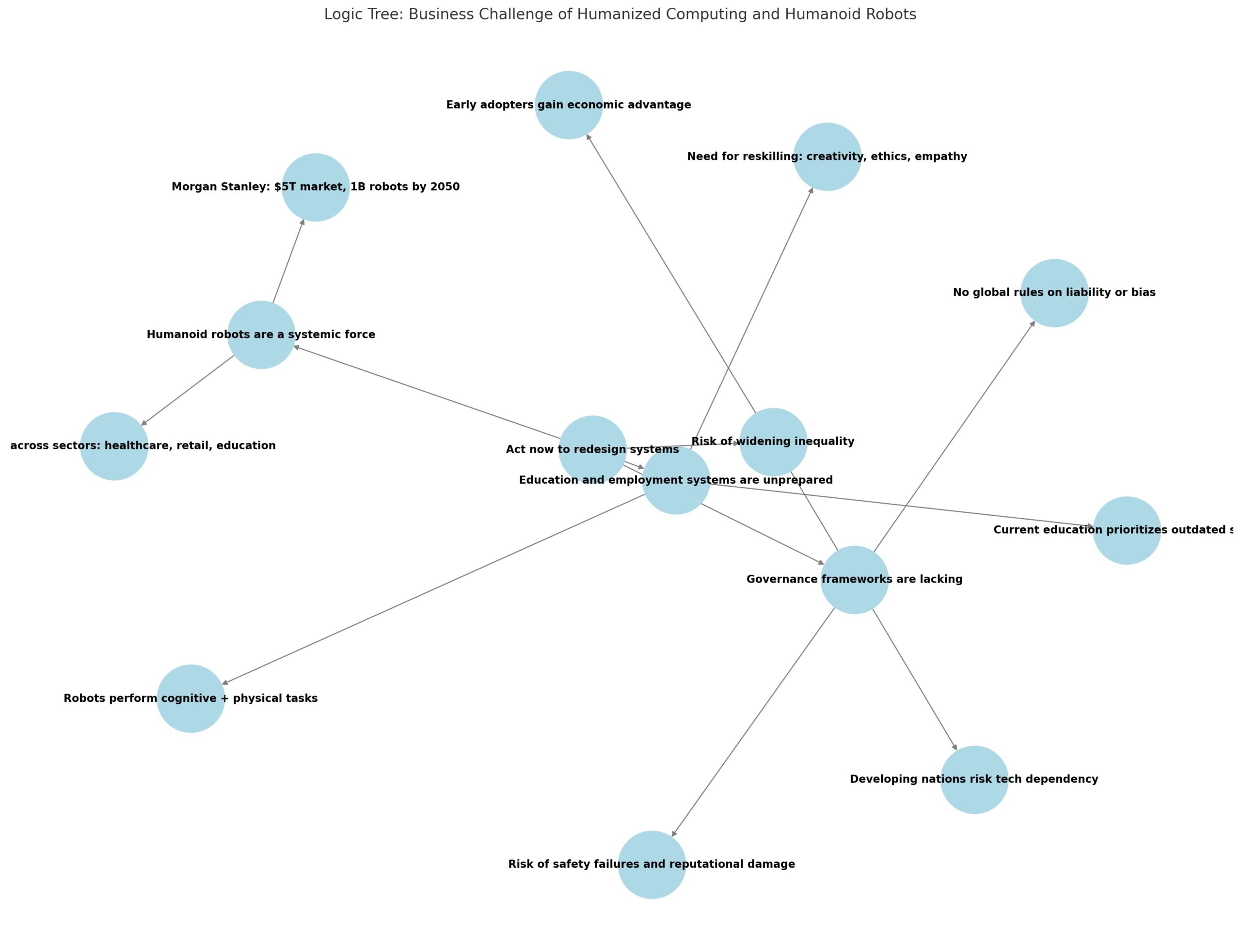
Despite this momentum, most public and private institutions remain woefully unprepared. Current education systems, labor frameworks, and regulatory policies were built for a pre-AI era — and without significant redesign, the arrival of humanoid robots could destabilize key societal structures.
1. The Scale of Disruption Is Underestimated
The transition from narrow automation to embodied AI marks a turning point. Today’s humanoid robots are capable of performing physical, cognitive, and interactive tasks — assisting in caregiving, customer service, surveillance, and delivery.
Bloomberg Intelligence (2024) projects more than 1 million humanoid units could be in deployment by 2030, marking a dramatic shift in global labor dynamics. Yet many industry leaders still view these machines as novelties rather than systemic enablers of new economic and service models (Financial Times, 2025b). This cognitive gap in leadership creates a lag in strategy, risking missed opportunities and reactive policy responses.
2. Education and Employment Systems Are Misaligned
While robots gain dexterity and contextual understanding, human skill development remains rooted in 20th-century priorities. Educational curricula continue to emphasize rote learning, logic, and linear reasoning — precisely the domains where AI now excels.
McKinsey & Company (2023) forecasts that tens of millions of jobs — especially mid-skill and service roles — may be displaced or significantly redefined. The World Economic Forum (2023) underscores the urgency of transitioning toward uniquely human capabilities such as empathy, ethics, creativity, and interdisciplinary problem-solving. Without large-scale reskilling and curriculum reform, entire workforces may find themselves unemployable in a machine-augmented economy.
3. Governance and Ethics Are Lagging Behind Deployment
As humanoids enter sensitive sectors — from healthcare to education to law enforcement — the stakes of poor governance rise. Inconsistent performance, opaque algorithms, and anthropomorphic design raise ethical and legal risks. FT reporting from 2025 documents real-world trials where humanoid robots failed to navigate public spaces, mishandled tasks, or confused human instructions (Financial Times, 2025b). These are not minor bugs — they reflect deeper gaps in accountability and oversight.
Agostini (2025), in his article Toward a Trusted Digital Europe, warns that explainability, human oversight, and legal transparency must be built into the design and governance of AI systems. Without these foundations, humanoids may operate without clear lines of responsibility — eroding public trust and institutional legitimacy (AI Now Institute, 2023; PwC, 2023).
….
The full article is available at:
🔗 https://medium.com/@tarifabeach/humanoid-robots-are-reshaping-strategy-are-institutions-ready-for-a-machine-augmented-society-4880c0195a9f
For keynote opportunities or to schedule a coaching session with board members or CxOs, please contact me directly at:
martino.agostini@gmail.com
0 comments
Here is no comments for now.