
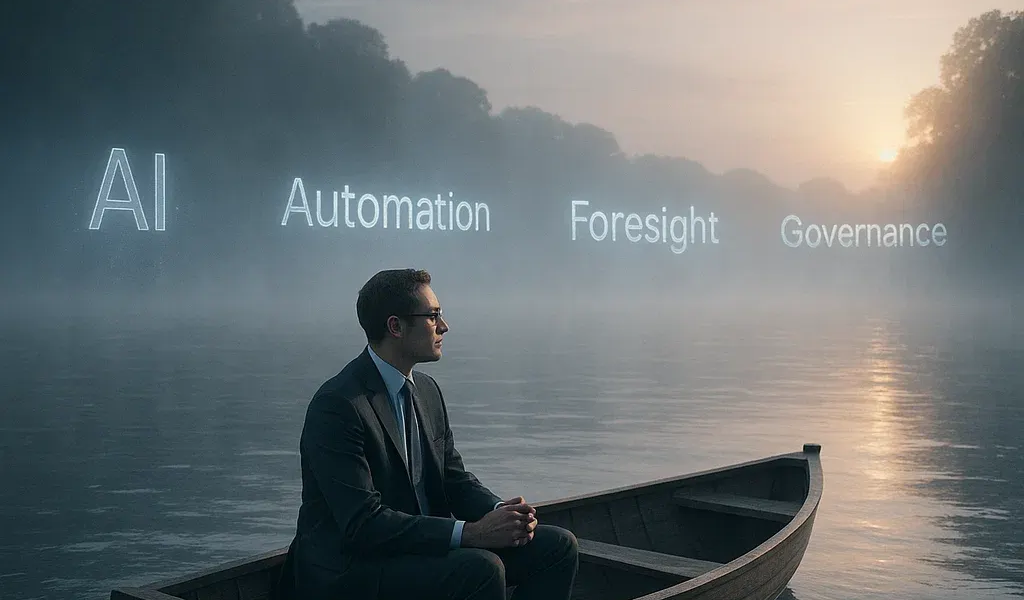
At dawn, a CEO was crossing a broad river — a rare moment of calm before another day of decisions. The fog was thick, the water still. Then, from the mist, another boat appeared and struck his.
Startled, he stood up, ready to shout — until he saw the truth: the other boat was empty.
He sat down again. The anger drained away as quickly as it had come. Then, faintly painted on the hull, he noticed a few words: AI. Automation. Quantum. Data. Governance.
In that moment, he understood. Disruption itself was not hostile — only his interpretation made it so. These were not threats or rivals but empty boats, neutral forces drifting on the current of change. The tension he felt came not from technology but from his own reaction, the human tendency to personalize uncertainty (Zhuangzi, 1968).
He smiled, picked up the oar, and adjusted his direction. The current was still strong, but now he was steering — not resisting.
The Empty Boat Mindset offers an enduring lesson for modern leaders. Technology has no intent; the stories we project onto it determine whether we see opportunity or threat (Watts, 1975). Between disruption and decision lies a narrow space — the pause where reaction transforms into foresight (Kabat-Zinn, 1994; Brown & Ryan, 2003). Ego resists change, but curiosity invites innovation (Osho, 1972). The world will not slow down, but clarity can. Leadership, at its best, is not about control — it’s about alignment with change.
The Taoist philosopher Zhuangzi (1968) taught that when an empty boat collides with yours, there is no one to blame. When we assume intent, we react. When we release it, we respond. The parable translates seamlessly to the present. Today’s “empty boats” — AI, automation, and new technologies — are not collisions to fear but currents to navigate.
Mindfulness grounds leaders in the present; strategic foresight extends that awareness into the future (Kabat-Zinn, 1994; Boston Consulting Group [BCG], 2025). Both cultivate perception — one within the moment, the other across time. Together, they form anticipatory leadership, the ability to remain grounded while sensing what lies ahead. The Empty Boat Mindset thus evolves into a dual skillset: inner stillness for emotional clarity (Brown & Ryan, 2003) and outer foresight for strategic direction (World Economic Forum [WEF], 2025). When composure meets anticipation, leadership becomes flow — not friction.
Awareness without foresight, however, remains reaction. To lead through turbulence, awareness must mature into preparation — the essence of strategic foresight. The Boston Consulting Group (2025) defines foresight as the use of data, analytics, and scenario planning to turn volatility into vision. Foresight enables leaders to detect weak signals early and act before disruption hits.
The World Economic Forum (2025) calls foresight a core leadership muscle, one that separates those who shape change from those who merely adapt to it. The Organisation for Economic Co-operation and Development (OECD, n.d.) extends this mindset to public governance: its foresight toolkit provides practical methods — horizon scanning, backcasting, and participatory design — to institutionalize long-term thinking.
Empirical evidence reinforces the case. Rohrbeck and Kum (2018) found that firms with mature foresight systems achieved 33% higher profitability and 200% greater market capitalization growth than peers without them. Foresight isn’t philosophy — it’s performance.
In foresight terms, the empty boat is not a threat; it is a signal — an early indicator of change. Leaders who can read the signal and steer early transform uncertainty into advantage. As Zhuangzi (1968) might say today, “When the AI boat drifts your way, don’t shout — steer.” The future rewards those who interpret the current, not those who resist it.
The Empty Boat Mindset and strategic foresight together define future-ready leadership. One teaches presence; the other, anticipation. Both begin with perception and demand humility. When perception becomes foresight and foresight becomes strategy, leaders stop fighting the future — they start designing it (WEF, 2025; OECD, n.d.).
💭 A Question for Reflection
If every disruption that collides with your leadership were just an empty boat, how might you choose to steer — differently, more calmly, and more consciously — toward the future you want to create?
📚 References
Boston Consulting Group. (2025, January 14). Navigating the future with strategic foresight. Boston Consulting Group. https://www.bcg.com/publications/2025/navigating-the-future-with-strategic-foresight
Brown, K. W., & Ryan, R. M. (2003). The benefits of being present: Mindfulness and its role in psychological well-being. Journal of Personality and Social Psychology, 84(4), 822–848. https://doi.org/10.1037/0022-3514.84.4.822 Add to Citavi project by DOI
Kabat-Zinn, J. (1994). Wherever you go, there you are: Mindfulness meditation in everyday life. Hyperion.
Organisation for Economic Co-operation and Development. (n.d.). Strategic foresight toolkit for resilient public policy. OECD. https://www.oecd.org/en/publications/foresight-toolkit-for-resilient-public-policy_bcdd9304-en.html
Osho. (1972). The empty boat: Encounters with nothingness. Rebel Publishing House.
Rohrbeck, R., & Kum, M. E. (2018). Corporate foresight and its impact on firm performance: A longitudinal analysis. Technological Forecasting and Social Change, 129, 105–116. https://doi.org/10.1016/j.techfore.2017.12.019 Add to Citavi project by DOI
Watts, A. (1975). Tao: The watercourse way. Pantheon Books.
World Economic Forum. (2025, July 15). Why strategic foresight ensures your organization is ready for the future. World Economic Forum. https://www.weforum.org/stories/2025/07/strategic-foresight-future-ready-organizations-wef/
Zhuangzi. (1968). The complete works of Chuang Tzu (B. Watson, Trans.). Columbia University Press.
0 comments
Here is no comments for now.