
In technology strategy, the second half of the chessboard is a phrase, coined by Ray Kurzweil, in reference to the point where an exponentially growing factor begins to have a significant economic impact on an organization’s overall business strategy.
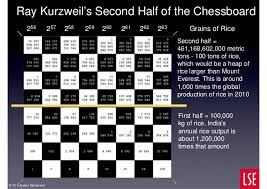
While the number of grains on the first half of the chessboard is large, the amount on the second half is vastly (232 > 4 billion times) larger.
The number of grains of rice on the first half of the chessboard is 1 + 2 + 4 + 8… + 2,147,483,648, for a total of 4,294,967,295 (232 − 1) grains of rice, or about 100,000 kg of rice (assuming 25 mg as the mass of one grain of rice). India’s annual rice output is about 1,200,000 times that amount.
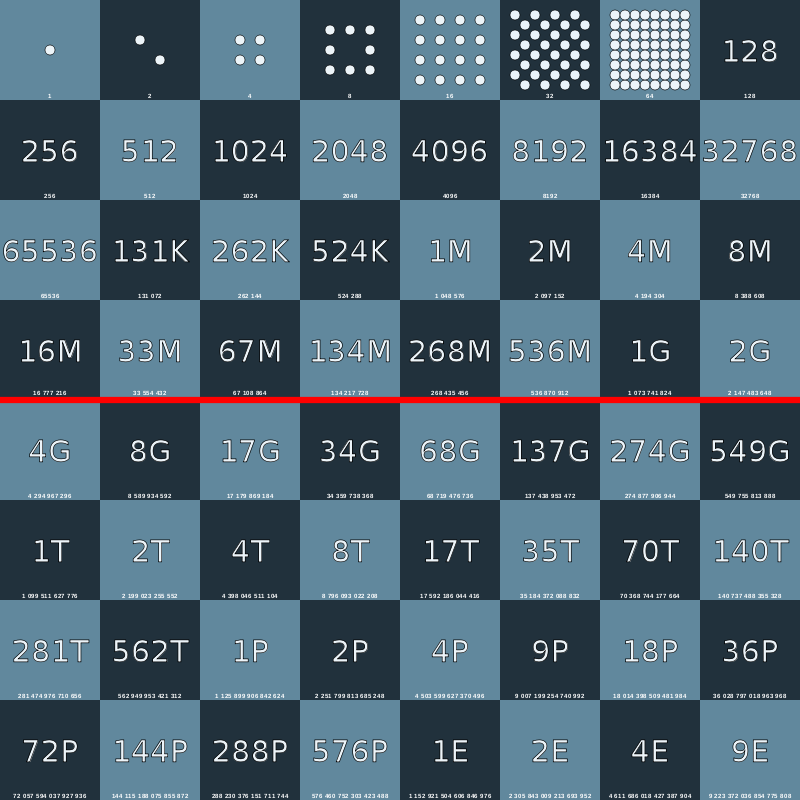
The number of grains of rice on the second half of the chessboard is 232 + 233 + 234 … + 263, for a total of 264 − 232 grains of rice (the square of the number of grains on the first half of the board plus itself). Indeed, as each square contains one grain more than the total of all the squares before it, the first square of the second half alone contains more grains than the entire first half.
On the 64th square of the chessboard alone there would be 263 = 9,223,372,036,854,775,808 grains of rice, or more than two billion times as much as on the first half of the chessboard.
On the entire chessboard there would be 264 − 1 = 18,446,744,073,709,551,615 grains of rice, weighing 461,168,602,000 metric tons, which would be a heap of rice larger than Mount Everest. This is around 1,000 times the global production of rice in 2010 (464,000,000 metric tons).
To sum up :

0 comments
Here is no comments for now.