

Abstract: This article investigate the concept of tokenized deposits and their impact on financial systems. Tokenized deposits are an innovative approach where traditional banking assets, such as deposits, are represented as digital tokens on a distributed ledger. The paper explores the key features and benefits of this novel financial instrument and its potential to revolutionize corporate banking.
Tokenized deposits offer several advantages, including increased liquidity, enhanced accessibility, and seamless integration with emerging blockchain technologies. The study highlights how these deposits, being fully regulated, provide a secure and transparent alternative for both banks and customers. Furthermore, they act as a bridge between conventional banking systems and the rapidly evolving landscape of digital assets.
The article also examines the challenges and potential risks associated with tokenized deposits, such as regulatory compliance, cyber threats, and market volatility. By understanding and addressing these concerns, financial institutions can effectively harness the advantages of tokenized deposits while safeguarding the interests of all stakeholders.
In conclusion, this article underscores the significance of tokenized deposits as a catalyst for corporate banking, especially in the context of the Distributed Ledger Technology (DLT) Pilot Regime. It emphasizes the need for careful consideration of regulatory frameworks and risk management practices to ensure the seamless integration of tokenized deposits into the broader financial ecosystem. By embracing this transformative financial instrument, financial systems can unlock new opportunities and drive innovation in the ever-evolving world of finance.
Some initial distinctions
An Electronic Money Token (EMT) serves as a cryptographic token for exchange and is tethered to a specific fiat currency. The primary contrast with an Asset-Referenced Token (ART) lies in its restriction to being pegged to a single fiat currency, exemplified by tokens like Tether or USDC. According to the Markets in Crypto-Assets (MiCA) regulations, EMTs must be backed by tangible real-world assets. For instance, if an issuer issues EUR 100,000 worth of a Euro-pegged EMT, they are required to hold EUR 100,000 (or assets denominated in EUR) in reserve, which could be stored in a vault or bank account. Similar to Electronic Money, which maintains a one-to-one equivalence with fiat currency, EMTs function similarly but are built upon Distributed Ledger Technology (DLT).
With the implementation of the MiCA framework, EMT issuers and providers will be subject to additional obligations, including:
-Supervision and regulation of all EMTs by the European Banking Authority (EBA).
-EMT issuers will be required to obtain both an E-money license (under the Electronic Money Directive) and a MiCA license to legally issue EMTs.
European „Markets in Crypto Assets Regulation“ (MiCAR): Types of crypto assets
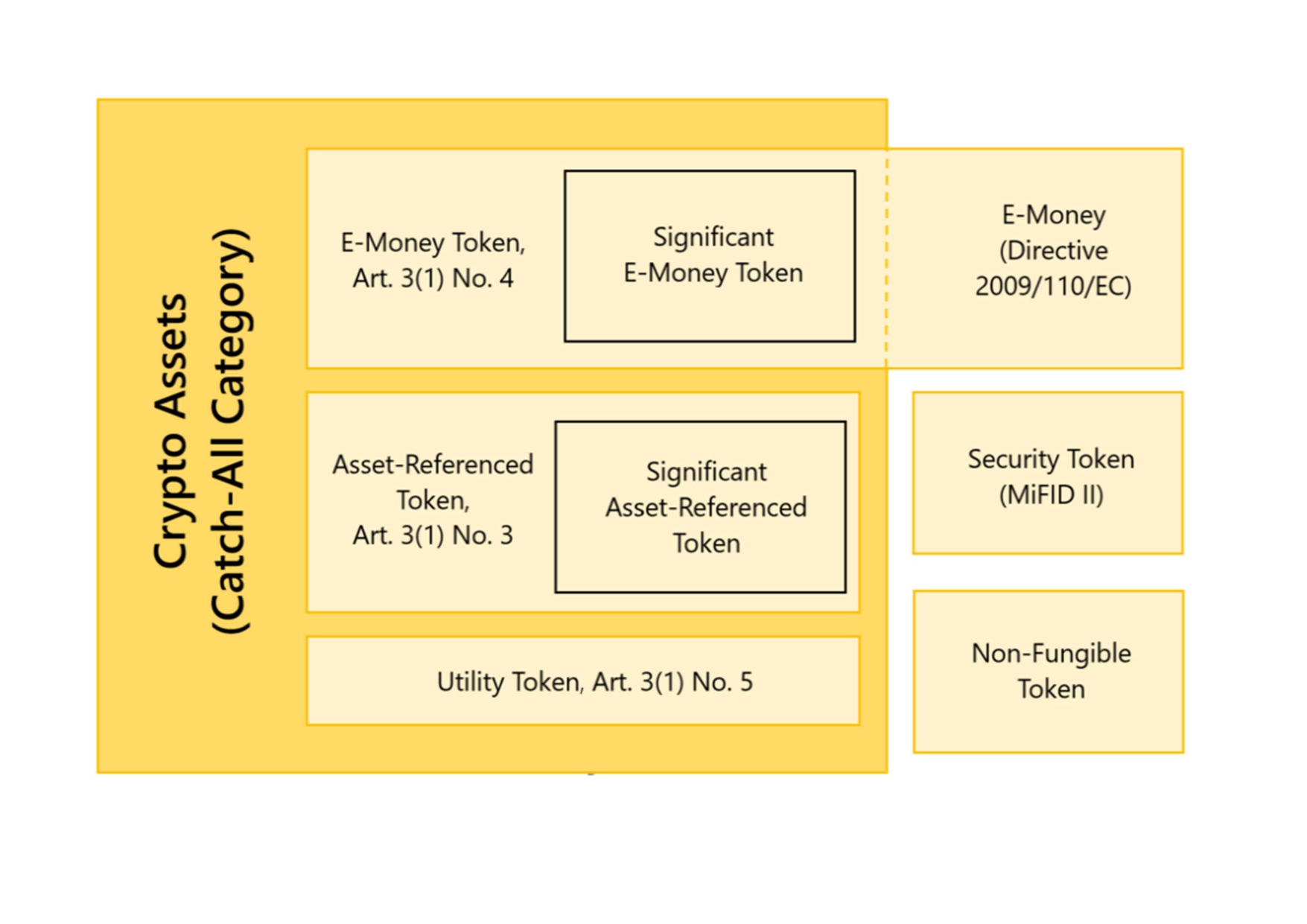
Source: https://www.lexology.com/library/detail.aspx?g=e8a26ed1-0513-411b-80c8-a8a7f14ee7fb
According to Videira (2023), it is essential to differentiate between coins and tokens. Coins are typically created either by a centralized authority, such as Central Bank Digital Currencies (CBDCs) or through mining processes like those employed by Bitcoin (Nakamoto, 2008) and Ethereum (Buterin, 2019). These mining protocols, nowadays, involve proof-of-work (PoW) for Bitcoin and proof-of-stake (PoS) for Ethereum. As a result, coins often operate on their own dedicated blockchain.
On the other hand, tokens represent digital versions of physical or financial assets and exist within an existing blockchain network. They can be claimed and exchanged on that blockchain. Additionally, tokens usually require a medium of exchange for settlement, such as deposit tokens and wholesale tokens. Alternatively, they can also function as bearer instruments (Garrat and Shin, 2023). During settlement, tokens possess a face value that can be exchanged at par or may experience slight variations. In some cases, their value might be subject to unconstrained fluctuations concerning a coin or stablecoin. This distinction between coins and tokens provides a clearer understanding of their underlying functionalities and roles within the blockchain ecosystem.
The market for tokenization is growing …
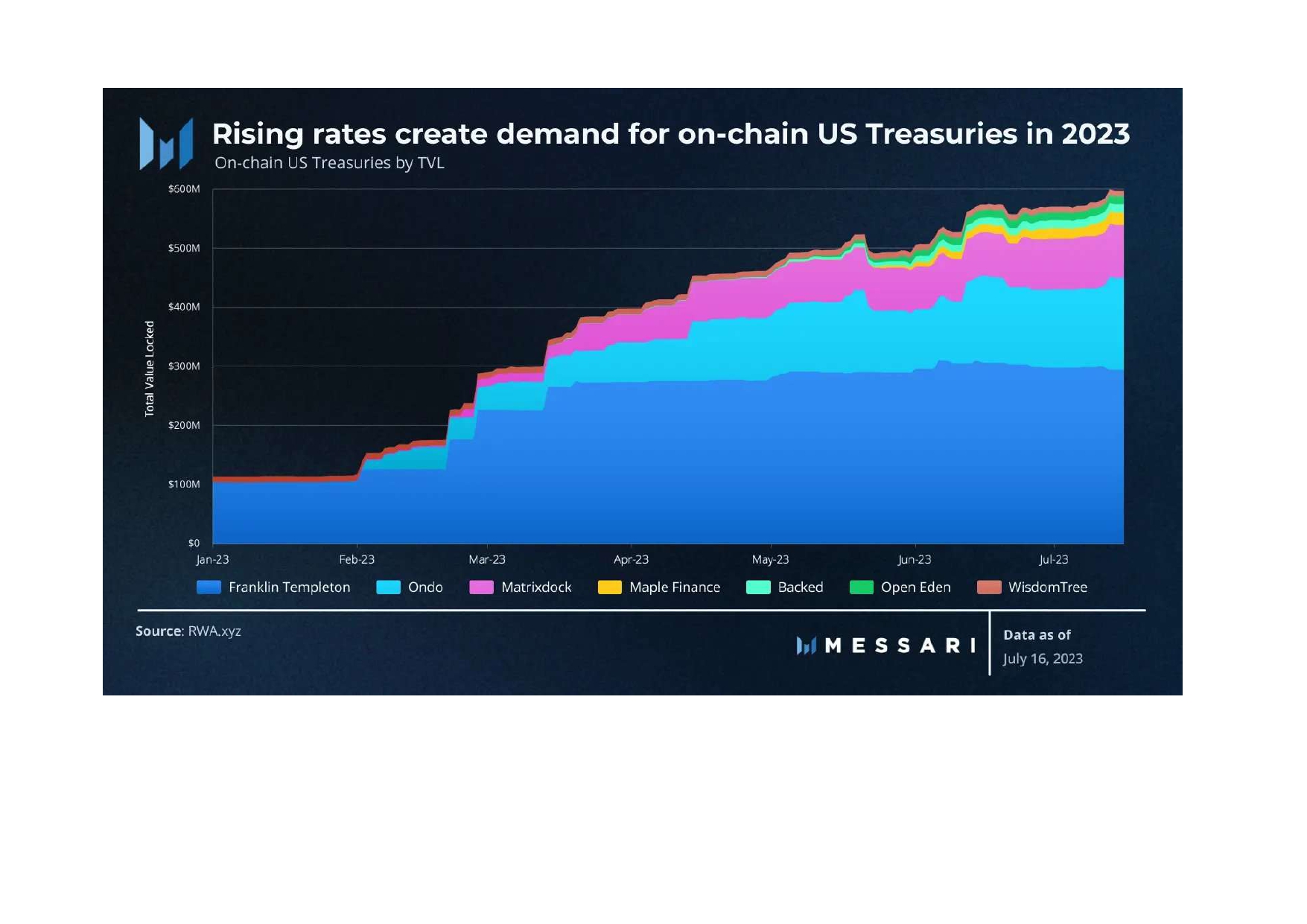
The development is driven by an increasing demand for tokenized versions of traditional financial instruments, particularly U.S. Treasuries, as investors seek alternatives to decentralized finance (DeFi) lending markets with soaring bond yields. Bernstein, a wealth management firm, predicts that the tokenization of real-world assets (RWAs) could reach a staggering $5 trillion market value within the next five years. Tokenized Treasuries have already made substantial strides, reaching a market worth $600 million.
As blockchain technology continues to advance for commercial applications, there is a pressing need for digital “cash equivalents” that can serve as liquid means of payment and store value within blockchain ecosystems. While stablecoins have so far served as the primary solution, the rising complexity of commercial transactions on blockchain platforms has sparked questions about the type of digital currency required to support large-scale payments.
Deposit tokens and central bank digital currencies (CBDCs) are currently under exploration as potential solutions to meet the evolving demands of digital money in the future. As the landscape of digital finance evolves, finding efficient and secure payment methods remains a crucial focus, and these emerging digital currency options hold promising potential.EBA encourages timely preparatory steps towards the application of MiCAR to asset-referenced and electronic money tokens
EBA encourages timely preparatory steps towards the application of MiCAR to asset-referenced and electronic money tokens
Under the EU’s Markets in Cryptoassets (MiCA) regulation, stablecoin operators must obtain a license from a national financial regulator in at least one member state by June 2024.
The European Banking Authority (EBA) has issued a statement targeting financial institutions and other entities intending to commence or have already started asset-referenced token (ART) or electronic money token (EMT) activities before 30 June 2024, which marks the application date for the relevant provisions of MiCAR. The statement aims to promote early preparatory measures for the implementation of MiCAR, with the objectives of minimizing potential disruptions and abrupt adjustments in business models at a later stage, promoting supervisory convergence, and safeguarding consumer protection.
Within this statement, the EBA presents “guiding principles” that financial institutions (and other entities) engaged in ART/EMT activities are encouraged to consider and adhere to until the application date. These guiding principles encompass aspects such as (i) ensuring transparent disclosures and fair treatment for potential acquirers and holders of ARTs and EMTs, (ii) establishing a robust business model, (iii) adopting sound governance practices, including effective risk management, (iv) implementing reserve, recovery, and redemption arrangements, and (v) maintaining clear communication channels with the relevant competent authority.
Deposit token
Deposit tokens are gaining significant attention as blockchain technologies continue to evolve, necessitating blockchain-native “cash equivalents” that can serve as liquid means of payment and stores of value in such environments. Historically, stablecoins fulfilled this demand, but the growing adoption of blockchain for complex transactions raises questions about the most suitable forms of digital money to facilitate value transfers.
Source: Oliver Wyman and Onyx by J.P. Morgan Analysis
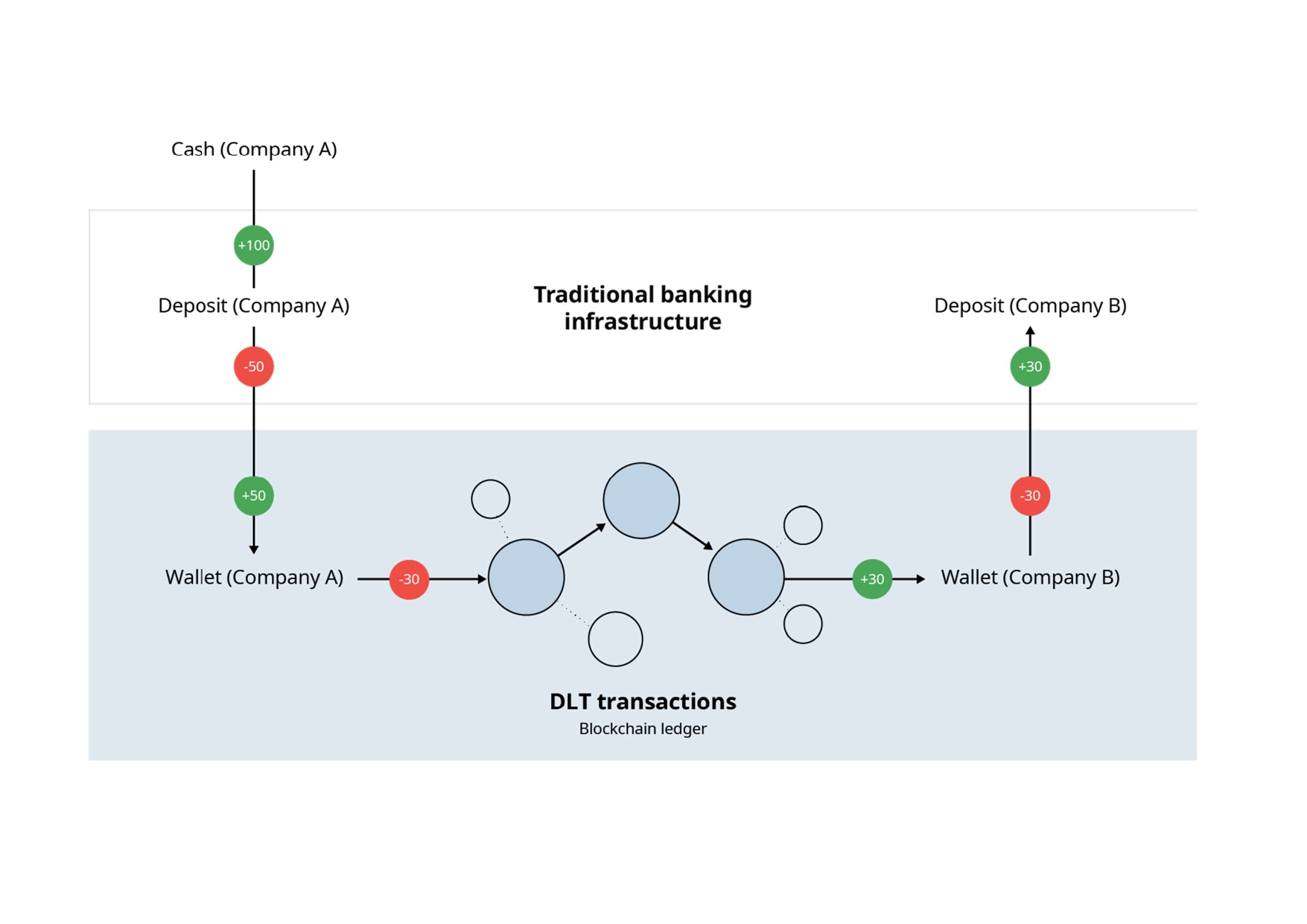
Blockchain-based deposit tokens are emerging as a promising solution. They represent deposit claims against licensed depository institutions, like commercial banks, but are recorded on a blockchain. For issuing banks, deposit tokens are a redistribution of deposit liabilities without altering their asset composition.
These tokens are regulated and supervised in the same way as traditional banks, subject to regulations on minimum capital, liquidity, and technology risk management. Deposit tokens have various use cases, including payments, trading, and collateral, offering features like programmability and instant settlement, which streamline transactions and automate payments.
The growing interest in deposit tokens signifies a paradigm shift in the future of finance, providing innovative solutions in an increasingly complex digital asset landscape.
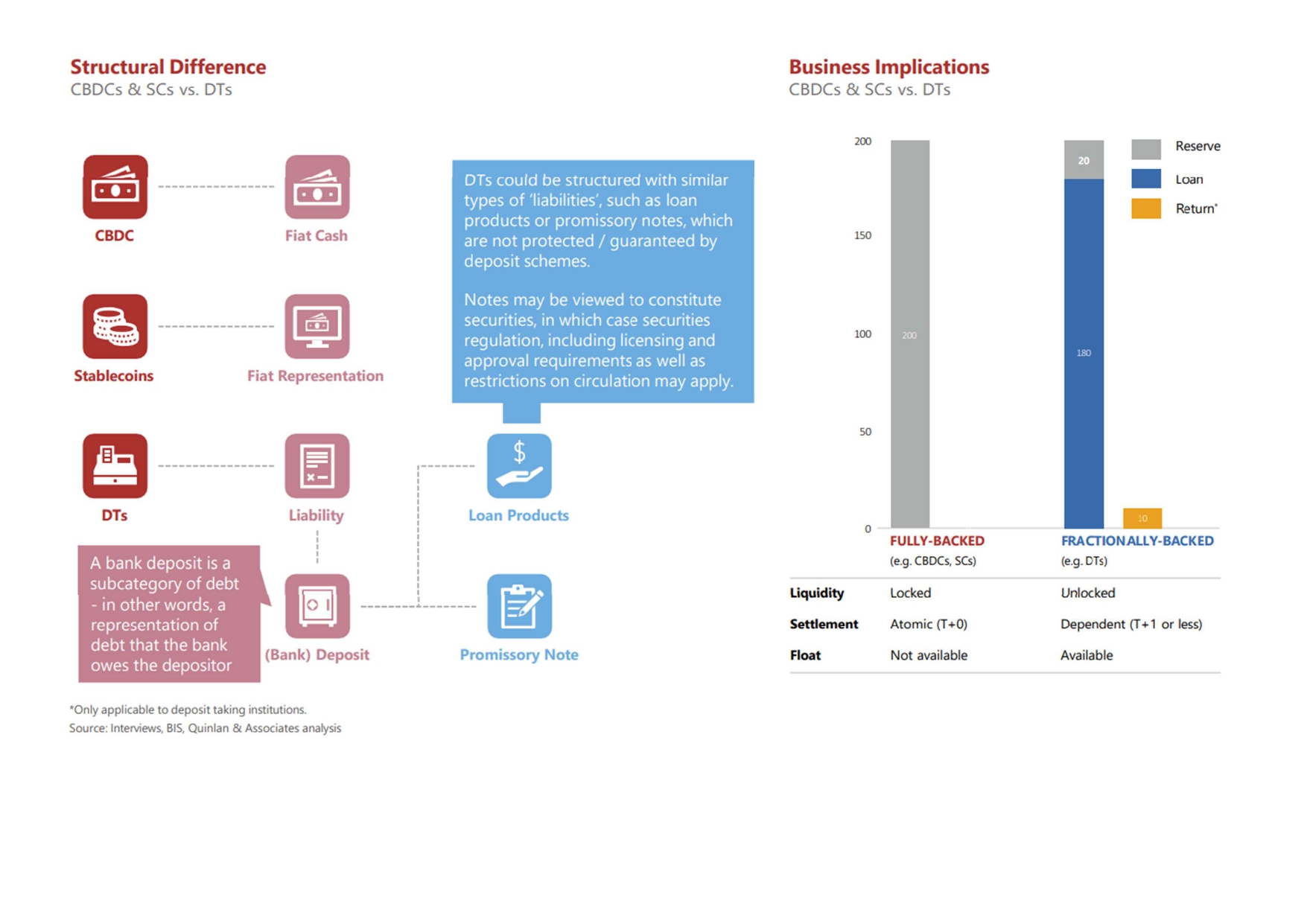
According to the Bank for International Settlements (BIS): CBDCs and SCs are designed, understood, and operate in a manner akin to traditional fiat currencies due to their fully-backed nature. In contrast, DTs represent commercial bank liabilities, such as bank deposits or promissory notes. If backed by bank deposits, DTs exhibit similarities with stablecoins, but if their backing involves other types of liabilities, they may fall under the purview of securities regulation.
The distinct characteristic of DTs as commercial bank liabilities presents unique challenges in their implementation compared to CBDCs and SCs. This difference in underlying structure renders DTs a more intricate digital asset to integrate and manage effectively.

Source: https://www.bis.org/about/bisih/topics/open_finance/dynamo.htm
Source: https://www.bis.org/about/bisih/topics/open_finance/dynamo.htm
Source: https://www.bis.org/about/bisih/topics/open_finance/dynamo.htm
Need to be considered that…
In the context of payment mechanisms between money issuers, an important consideration involves the process by which transactions are conducted. When one party initiates a payment, the sender’s token balance at their institution is reduced, and simultaneously, new tokens are issued to the receiver at their respective bank or payment service provider. This concurrent transfer of central-bank money plays a crucial role and is facilitated through a wholesale central bank digital currency (CBDC), which ensures accurate bookkeeping.
In the context of Central Bank Digital Currencies (CBDCs), a significant challenge arises concerning the offline puzzle. This entails ensuring that a CBDC can maintain the provision typically associated with cash while simultaneously preventing issues like double-spending and counterfeiting. The solution to this puzzle involves minting the CBDC coins in serials, storing them on a local blockchain (e.g., smartphone), and securing the local blockchain with hardware-embedded keys. Additionally, continuous mining by the wallet enhances security. The CBDC coins can be minted either as hot coins, which can be retrieved in case of loss, or as cold coins, similar to physical cash (Videira, 2023).
On the other hand, many central banks, including the European Central Bank (ECB), contemplate the creation of a digital public currency, potentially taking diverse forms and having varied implications. If a CBDC were to be established based on a full-fledged digital account, widely accessible to the public, and capable of remote liquidity transfers, it could have disruptive consequences for banks and credit. Alternatively, adopting a token-based solution presents its own set of technical, security, and privacy challenges (Mottura, 2022).
Given these considerations, careful assessments from technical, legal, and ultimately political perspectives are crucial in making the right choice. It is essential to strike a balance that preserves the unifying social function of legal money while ensuring that it does not jeopardize credit to the economy or disrupt the established collaborative relationship between central banks and private banks.
What are the banks doing?
Prominent banking institutions are leading the way in advancing financial innovation through tokenized deposit projects. These initiatives aim to introduce tokenized representations of traditional assets, enhance payment processes, and security, and explore blockchain technology’s potential. Projects by the Swiss Banking Association, German banks, and the Mastercard Multi-Token Network (MTN) are reshaping digital finance and fostering a more interconnected and technologically advanced financial landscape.
–Swiss Banking Association (SBA) coordinates a tokenized deposit project with a dozen banks, aiming to introduce a tokenized Swiss Franc. Participating banks include BCV, Credit Suisse, Entris Banking, Hypothekarbank Lenzburg, InCore Bank, Julius Baer, PostFinance, Sygnum, UBS, Vontobel, VZ Depotbank, and Zürcher Kantonalbank.
–Germany’s DZ Bank and other banks collaborate with four corporates on a proof of concept for deposit tokens. The participating banks are Commerzbank, Helaba, and Unicredit. They use a model developed in conjunction with the four major German banking associations for commercial bank money tokens (CBMT). The CBMT system enables clients of different banks to pay each other using digital currency on third-party DLT networks, such as consortium blockchains with corporate customers as the target users. The German Banking Industry Committee (GBIC) makes public a working paper proposing the use of deposit tokens among commercial banks in the country.
–Mastercard is piloting a Multi-Token Network (MTN) in the UK testbed. The pilot starts with testing tokenized bank deposits and will later explore experiments involving stablecoins and CBDCs
The latest survey conducted by the Bank for International Settlements (BIS) reveals a significant acknowledgment from central banks worldwide regarding the potential benefits of both a retail Central Bank Digital Currency (CBDC) and a fast payment system. With over 80% of central banks recognizing the value of integrating these innovative solutions, it underscores the growing importance of digital currencies and blockchain technology in shaping the future of global financial systems. As central banks continue to explore and implement CBDCs and cryptocurrencies, these developments hold the promise of revolutionizing payment processes and fostering greater financial inclusivity and efficiency on a global scale. For more in-depth insights on this subject, refer to the detailed survey report at the provided link: https://bit.ly/3JNTQQa.
Conclusion
While deposit tokens are emerging as a viable alternative to stablecoins, they are not intended to replace them entirely. Instead, they offer a complementary asset class that may find increasing favor among institutional investors. However, for broader adoption in the retail sector, a solution from Central Banks connected with wholesale Banks is essential to ensure the security of offline and online payments, addressing technical and regulatory concerns. The crypto industry’s diverse nature allows for a wide range of digital assets, catering to various users and purposes. As the sector evolves, it remains crucial for industry leaders to prioritize consumer protection and transparency, delivering a more inclusive and efficient alternative to traditional finance. Striking the right balance between innovation and safeguarding consumer interests will be instrumental in shaping the future of the financial landscape.
Additional Resources
Are stablecoins becoming a profound collaboration paradox?
Embracing Innovation in Capital Markets: CBDCs
How Deposit Tokens Are Changing The Digital Money Ecosystem: A foundation for stable digital money
(Mottura, 2022) Cbdc and Digital Euro: token-based or account-based?
Project Polaris: Handbook for offline payments with CBDC
Stablecoins versus tokenized deposits: implications for the singleness of money
The Deposit Token- New money for digital Switzerland
The German Banking Industry Committee (GBIC) has made public a working paper for using deposit tokens among commercial banks in the country.
(Videira, 2023 ) The offline digital currency puzzle was solved by a local blockchain
0 comments
Here is no comments for now.